 voella
Updated 21 November 2026
How to stop being so soft-spoken
Being soft-spoken isn’t a flaw. The trouble starts when people can’t hear you: in meetings, in groups, at a counter, on a call. The goal isn’t to become loud. It’s to move your everyday voice one step up.

Is being soft-spoken a bad thing?
No. A soft voice often comes across as calm, warm and thoughtful, and plenty of people like it. It only becomes a problem when it stops working: people ask you to repeat yourself, talk over you in groups or miss what you said, and you start avoiding calls, orders and meetings because you expect to be missed.
That part is fixable, and you get to keep the calm.
Why some people are soft-spoken
- Temperament. Many quiet, reserved people simply default to a lower volume.
- Habit. If you grew up in a quiet home or were often told to keep it down, a soft voice became normal.
- Breath. Speaking from a shallow breath, or at the very end of one, leaves little air for volume.
- Nerves. For some people a quiet voice is a way to avoid attention, especially in groups.
- Your own ears. You hear your voice through the bones of your head, so it sounds louder to you than it does to others. More on that in why people ask you to repeat yourself.
Where your voice sits now
Think of volume as a ladder with five steps. Most soft-spoken people use step two for everything.
- Whisper For secrets. Nobody past arm’s length hears it.
- Soft One person, close by. Where many soft-spoken people stay all day.
- Table Across a table. Everyday conversation.
- Room Across a room, a meeting or a counter. Aim here when it matters.
- Shout Emergencies only. It strains your voice.
The fix isn’t to live on step five. Keep the soft voice for close, quiet moments, and learn to step up to three or four on purpose when the room needs it.
Six steps to being heard
1. Aim one step up, not loud
Loud is a scary target, and it pushes you toward the throat. Aim for one step up the ladder instead. A friend can help: ask them to sit across the room and tell you when they hear you easily.

2. Breathe before the first word
Quiet speakers often start talking on whatever air is left. Take one low breath, belly out and shoulders still, and start on it. A full breath is what lets a voice step up without strain.
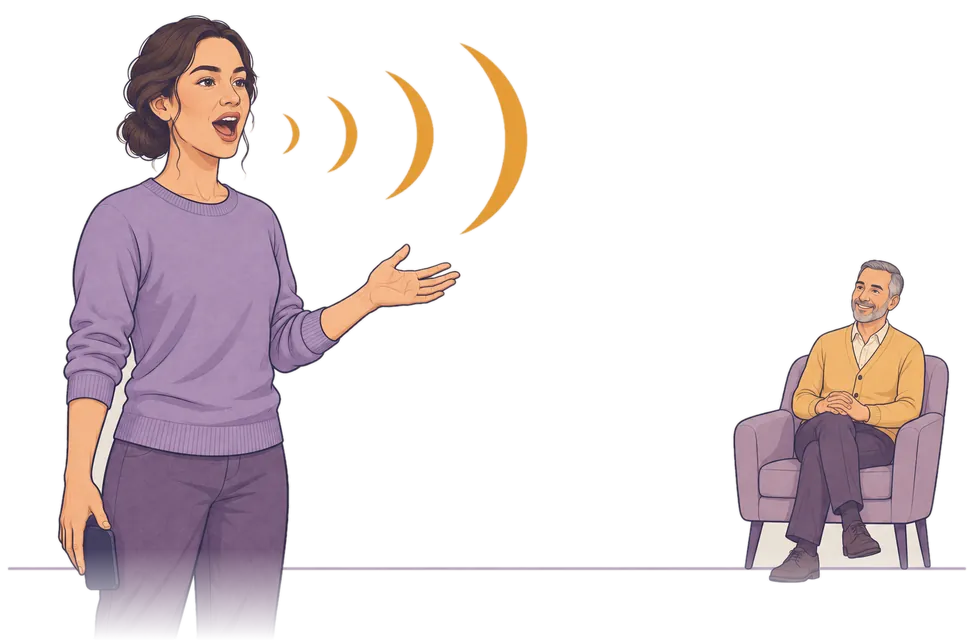
3. Talk to the farthest person
Your voice goes where you aim it. In a group, pick the person farthest from you and talk to them; everyone closer will hear you too. Look up from your phone, notes or the table, since a voice aimed down gets lost.
4. Start strong and finish strong
Soft-spoken people often start a sentence hesitantly and let the end fade. Put a full breath behind the first word, and land the last one as clearly as the first. The end of a sentence usually carries the point.
I think we should try the second option.

5. Rehearse the lines you actually need
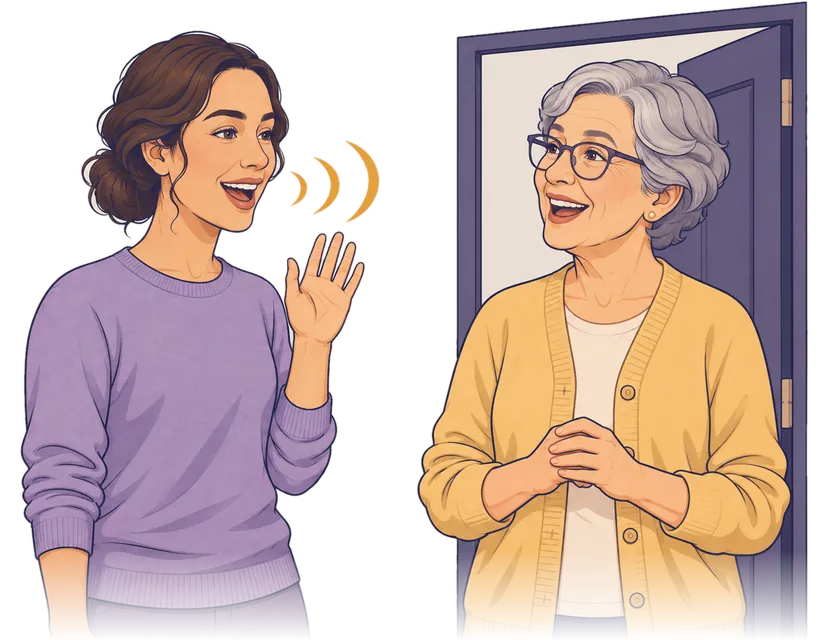
Practice the exact sentences you find hard, out loud and at step four: ordering, saying your name, joining a conversation. Rehearsed words come out steadier when it counts.
Could I get a large coffee, please?
Three lines you say every week, out loud
6. Practice a few minutes every day
A stronger everyday voice is a habit, and habits come from repetition. Five minutes a day of voice projection exercises does more than an hour once a month. Record yourself once a week so you can hear the change.
5 minutes a day, one recording a week
In meetings and groups
- Sit at the table, where people can see your face.
- Say something in the first few minutes. Speaking again is easier once you have spoken once.
- Join at a pause with a short opener, like “Can I add something?”, at step four, then keep that volume.
- If someone starts talking over you, finish a few more words instead of stopping right away.
- On calls, use a headset or earbuds with a mic, or move closer to your laptop.
Soft-spoken as a man
Many soft-spoken men try to fix it by pushing their voice lower and louder from the throat. It tends to sound forced and tires the voice quickly. Keep your natural pitch and use the same tools: a low breath, an open mouth and a clear aim. A clear voice at a comfortable pitch carries better than a forced deep one.
What not to do
- Don’t shout or squeeze your throat. How to speak louder without yelling shows the difference.
- Don’t speed up to get it over with. Fast and quiet is the hardest speech to follow.
- Don’t start with an apology. Skip “sorry, just quickly” and say the point.
When to talk to a doctor
If your voice has become quieter, weaker or hoarse recently without a clear reason, see a doctor. The NIH says hoarseness that lasts more than three weeks, pain when speaking or swallowing, or losing your voice for more than a few days should be checked. This guide is practice, not medical advice.