 voella
Updated 15 November 2026
Why do people always ask me to repeat myself?
Hearing “sorry, what?” again and again wears you down. It is rarely one big problem. Usually two or three small habits add up, and habits can change.

You can’t easily judge your own volume
You hear your own voice partly through the bones of your head, not only through the air, which is why it sounds fuller to you than on a recording. That makes your own loudness hard to judge: a voice that feels normal to you can arrive faint at someone a few steps away. A quick recording settles it, and there’s a test below.
The common reasons
- Your volume is set for a quiet room. In a café, an office or a car, the same voice disappears.
- Your sentences fade at the end. The last words often carry the meaning, and they are the ones that get lost.
- You speak quickly or with a small mouth. Words blur together and lose their edges.
- Your voice is breathy. A voice with more air than tone is hard to hear over background noise.
- You face away or look down. Your voice goes where your mouth points. Speaking to the floor, to a screen or from behind your hand muffles it.
- The room is noisy. Restaurants, open offices and cars make every voice harder to hear, and quiet voices go first.
- It’s a habit. Many soft-spoken people learned early to keep their voice down. That is a habit, not a flaw.
And sometimes it isn’t you. If one particular person always asks you to repeat yourself, their hearing may be part of it.
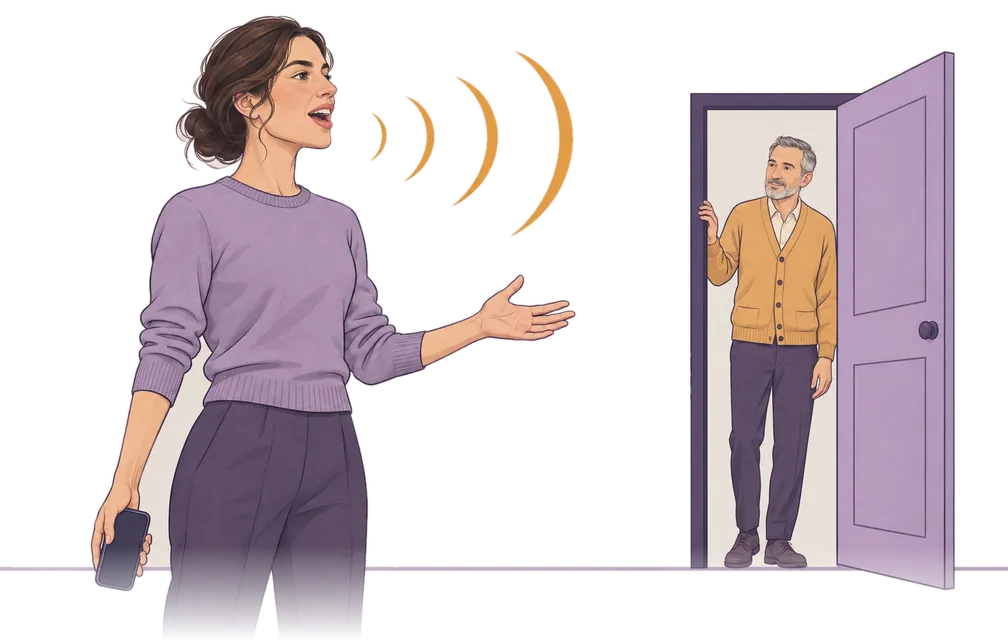
A two-minute test
Put your phone on the other side of the room and start a voice recording. Say the line below at your usual volume. Then record it again, this time aiming your voice at the phone. Play both back. Can you understand every word of the first one? The difference is usually obvious.
Good morning, everyone. Before we start, I have one quick thing to share.
2 recordings, about a minute

What helps
- Breathe low before you start, so you have air for the whole sentence. How to speak louder without yelling covers this step by step.
- Aim your voice at the person, not at the space just in front of you.
- Open your mouth wider and slow down. See how to stop mumbling.
- Land the last word of every sentence.
- In noisy places, move closer and face people.
- Practice a few minutes a day so the stronger voice becomes your normal one. These voice projection exercises are a good start.
- If you’re quiet in general, read how to stop being so soft-spoken.
When it might be medical
If your voice has recently become weaker, quieter or hoarse without a clear reason, see a doctor. The NIH says hoarseness that lasts more than three weeks, pain when speaking or swallowing, or losing your voice for more than a few days should be checked. A quiet voice can also be a sign of conditions that affect the nerves and muscles you speak with.